
Can I Open My Garage Door with a Broken Spring in Cold Spring, MN?
Quick Answer
Yes, you can open a garage door with a broken spring, but it is dangerous and should only be done in an emergency. Without the spring, the door is no longer counterbalanced and can weigh between 150 and 300+ pounds, depending on size and insulation.
In most cases, the safest move is to leave the door closed and have it repaired as soon as possible.
What Happens When a Garage Door Spring Fails
If your garage door spring breaks, your first instinct is usually to get the door open—especially if your car is stuck inside. Technically, yes, you can open a garage door with a broken spring. But in real-world conditions, it is rarely something you should do unless it is an emergency.
In Cold Spring, where winter conditions already put extra stress on garage doors, a broken spring turns a balanced system into a heavy, unpredictable system. What used to open smoothly now becomes difficult, unstable, and potentially dangerous to operate.
What Actually Happens When a Spring Breaks
Garage door springs carry nearly all the weight of the door. When they are working properly, the system feels light and controlled. The opener simply guides the door—it does not lift it.
When a spring breaks, that balance disappears instantly. The full weight of the door shifts onto the system and onto you if you try to lift it manually. This is why the door suddenly feels extremely heavy or refuses to open.
In many cases, the door also becomes uneven. One side may lift slightly while the other binds in the track. This imbalance puts added stress on cables, rollers, and hinges, which is why additional problems often follow if the door continues to be used.
How Heavy the Door Really Is (This Is Where It Gets Risky)
Most homeowners underestimate how much weight the spring is offsetting. In practical terms, lifting a garage door with a broken spring is similar to trying to deadlift a 250 to 300 pound object that can shift unexpectedly.
Unlike a fixed weight, the door moves along tracks and can suddenly lose balance. That instability is what makes it dangerous. It is not just about strength, but about controlling a heavy system that was never designed to be lifted without assistance.
Why Opening the Door Is Risky
Opening a garage door with a broken spring introduces several risks at once. The door becomes unstable and can tilt, bind, or drop unexpectedly during lifting. Even if you manage to get it open, keeping it safely in place becomes another challenge.
There is also the physical strain to consider. The uneven load and awkward lifting position increase the risk of back and shoulder injuries. At the same time, the opener itself is not designed to carry the full weight of the door. Forcing it to do so can strip gears, bend rails, or burn out the motor quickly.
The Cold Spring, MN Factor (Why Springs Break Here)
In Cold Spring, garage door springs tend to fail more often because of local environmental conditions. Cold temperatures cause metal to contract, increasing internal tension within the spring. Over time, repeated freeze cycles weaken the metal.
At the same time, proximity to the Sauk River and nearby lakes increases humidity levels. Moisture settles on the spring during warmer months and leads to corrosion, often visible as light rust along the coils. When the first deep freeze hits, that weakened metal becomes brittle and snaps.
This is why many homeowners hear a loud bang in the garage during winter. It is often the spring breaking under stress.
Cold Spring Service Reality (Why This Matters Fast)
Whether you are in a historic home near St. Boniface or in a newer development off County Road 2, a broken spring usually happens at the worst possible time—early morning or late evening when you need to leave.
In Cold Spring, many homeowners rely on their garage as the primary entry point, especially during winter. If the door will not open, it can completely disrupt your day, especially if you need to commute toward St. Cloud or the Twin Cities.
That is why broken spring repairs are treated as urgent service calls.
When It Might Be OK to Open the Door
There are only a few situations where opening the door makes sense.
If your vehicle is trapped and you need to leave for work or an emergency, you may have no choice but to open it manually. Even then, it should be treated as a one-time action—not a temporary workaround.
In Cold Spring, once a spring breaks, the door should be considered out of service until repaired.
Emergency Only: How to Open the Door Safely
If you absolutely must open the door, this needs to be treated as a controlled, one-time operation. The goal is not convenience—it is getting access without losing control of the door or damaging the system further.
Pull the Red Cord
Start by disconnecting the opener using the emergency release cord. This prevents the motor from trying to lift a full-weight door, which can strip gears or burn out the opener. Once disconnected, the door is no longer assisted in any way—it is entirely manual and fully weighted.
Visual Check
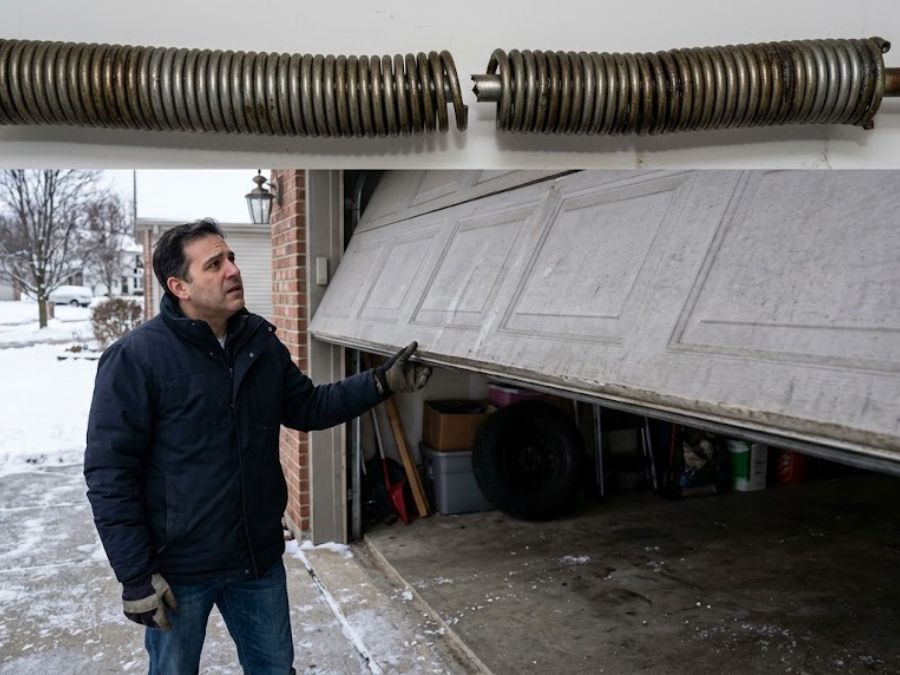
Before touching the door, take a moment to confirm what you’re dealing with. Look above the door for a visible gap in the spring. A broken torsion spring typically separates by one to two inches. Also glance at the cables on both sides. If one side looks loose or uneven, the door is already out of balance and will be harder to control.
Clear the Area
Make sure nothing is in the path of the door. Move vehicles, tools, and especially keep children and pets out of the garage. You want a clean, controlled space with no distractions or hazards while lifting.
Team Lift
This is not a one-person job. You need at least two people positioned on opposite sides of the door. Each person should take a firm grip near the bottom section, staying balanced with each other. Communication matters here—both sides need to move together.
Lift Slowly and Evenly
Begin lifting gradually, keeping both sides moving at the same pace. If one side rises faster than the other, the door can bind in the tracks or twist slightly, which increases the risk of it slipping. Expect resistance—the door will feel significantly heavier than normal.
Pause and Recheck as Needed
If the door feels unstable at any point, stop and reset your grip. Do not rush the lift. Small adjustments during the process can prevent larger problems.
Clamp the Track Immediately
Once the door is fully open, secure it right away. Use locking pliers or heavy-duty clamps on both tracks, positioned just below the bottom rollers. This acts as a physical stop and prevents the door from sliding back down. Never rely on the door to stay open on its own—without a functioning spring, it will not hold.
Stay Clear at All Times
Even after clamping, avoid standing directly underneath the door. Treat it as unstable. If something shifts or a clamp slips, you want to be out of the line of movement.
Do Not Repeat the Process
This is strictly a temporary solution for emergency access. Once the door has been opened, it should remain out of service until the spring is replaced and the system is properly balanced again.
What You Should NOT Do
When a garage door spring breaks, most of the damage I see doesn’t come from the break itself—it comes from what people try to do afterward. This is where small mistakes turn into expensive repairs or serious safety risks.
Do not continue pressing the opener
It’s tempting to keep hitting the wall button or remote, hoping the door will push through. The problem is, your opener is not designed to lift the full weight of the door. It’s only meant to guide a balanced system. When the spring is broken, that balance is gone, and the opener is suddenly doing a job it was never built for.
Keep forcing it, and you can strip internal gears, bend the rail, or burn out the motor entirely. What started as a spring replacement can quickly turn into needing a new opener as well.
Do not attempt to lift the door alone
This is one of the most common and most dangerous mistakes. Without the spring, the door can weigh several hundred pounds, and more importantly, that weight is not evenly distributed.
When you try to lift it by yourself, one side can rise faster than the other, causing the door to twist or bind in the tracks. If it slips, it can drop suddenly with very little warning. That’s how people end up with back injuries, shoulder strain, or worse. Even if you’re physically strong, this isn’t about strength—it’s about control. And a broken spring takes that control away.
Do not try to “hold” the door open
Some homeowners manage to get the door up and assume they can just leave it there temporarily. Without a functioning spring, the door has no reliable way to stay in position. It can slowly drift down or drop unexpectedly.
Leaning a ladder, a board, or any object under the door is not a safe solution. If the door shifts, that support can fail instantly. If the door needs to stay open, it must be mechanically secured using proper clamps on the tracks.
Do not attempt to repair the spring yourself
Garage door springs operate under extreme tension, and that tension doesn’t disappear just because the spring has broken. In fact, a damaged spring can behave even more unpredictably.
Proper spring replacement requires specific tools, controlled winding techniques, and a clear understanding of how to safely manage that stored energy. Attempting to loosen, adjust, or replace a spring without that setup can result in a sudden release of force.
This is one of those repairs where experience and equipment matter. It’s not a typical DIY project, and treating it like one is where serious injuries happen.
The Real Cost of Forcing It
A broken spring is usually a straightforward repair when handled the right way. The problem starts when homeowners try to force the system to keep working as if nothing has changed.
Once the spring fails, the entire load shifts onto parts that were never designed to carry it. The opener takes on far more strain than it should, which can lead to stripped gears, a bent rail, or a burned-out motor. At the same time, the tracks can begin to flex or bend under uneven pressure, especially if the door is being forced up or down repeatedly.
You also start to see uneven wear across the system. Cables stretch, rollers wear down faster, and hinges take on stress they weren’t built for. What began as a single-point failure quickly spreads into multiple components needing attention. That’s where the cost changes. Instead of a controlled spring replacement, you’re now dealing with additional parts, more labor, and a longer repair timeline. What should have been a routine fix turns into a broader system repair that could have been avoided by stopping early.
When to Call a Professional
If your garage door suddenly feels heavy, will not open, or you hear a loud snap or bang, the spring has likely failed.
At that point, the safest move is to stop using the door completely. A professional can replace the spring, rebalance the system, and ensure everything is operating safely.
Bottom Line
Yes, you can open a garage door with a broken spring—but in Cold Spring conditions, you almost never should.
The risks to your safety and the potential damage to your system outweigh the short-term convenience. The correct move is to treat the door as out of service and repair it as soon as possible.